

Fentanyl is a synthetic opioid far stronger than morphine, posing serious risks to workplace safety. Despite its dangers, standard drug tests often fail to detect fentanyl, leaving significant gaps in pre-employment screening. Employers now face growing pressure to address this issue by incorporating specialized fentanyl testing into their hiring processes.
Key points:
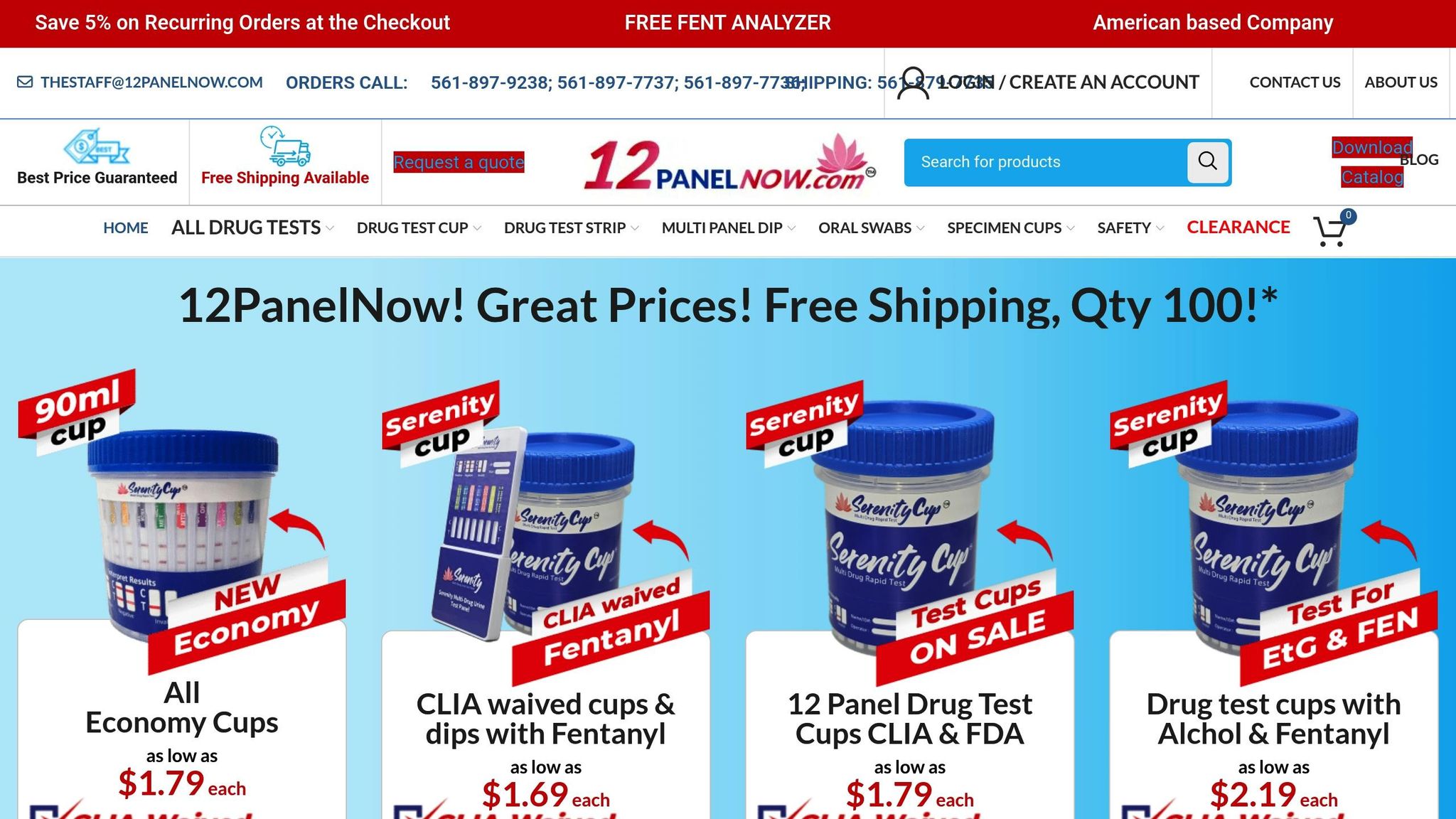 12PanelNow offers a variety of fentanyl testing products tailored for workplace screening programs. Their multi-panel drug test cups detect fentanyl and other substances, with options ranging from 5 to 28 panels. These cups include features like temperature strips and leak-resistant designs, with prices starting at $1.29 and going up to $4.29, depending on the number of panels.
For targeted synthetic opioid detection, their single drug test strips provide 99% accuracy at competitive prices between $0.29 and $0.69. These strips are versatile enough for both workplace and forensic use.
The company also offers oral swab tests, which are priced between $1.99 and $2.49. These non-invasive tests are ideal for environments where privacy is a concern or urine testing isn’t practical.
All 12PanelNow products are CLIA-waived and FDA-approved, ensuring they meet federal regulations. They also offer bulk purchasing options with custom pricing for large-scale needs and provide same-day shipping to avoid testing delays. Serving workplaces, healthcare facilities, rehabilitation centers, and government agencies, 12PanelNow delivers reliable solutions that meet the demands of pre-employment screening programs.
12PanelNow offers a variety of fentanyl testing products tailored for workplace screening programs. Their multi-panel drug test cups detect fentanyl and other substances, with options ranging from 5 to 28 panels. These cups include features like temperature strips and leak-resistant designs, with prices starting at $1.29 and going up to $4.29, depending on the number of panels.
For targeted synthetic opioid detection, their single drug test strips provide 99% accuracy at competitive prices between $0.29 and $0.69. These strips are versatile enough for both workplace and forensic use.
The company also offers oral swab tests, which are priced between $1.99 and $2.49. These non-invasive tests are ideal for environments where privacy is a concern or urine testing isn’t practical.
All 12PanelNow products are CLIA-waived and FDA-approved, ensuring they meet federal regulations. They also offer bulk purchasing options with custom pricing for large-scale needs and provide same-day shipping to avoid testing delays. Serving workplaces, healthcare facilities, rehabilitation centers, and government agencies, 12PanelNow delivers reliable solutions that meet the demands of pre-employment screening programs.
- Fentanyl is 50-100x stronger than morphine, with analogs like carfentanil being even more potent.
- Standard drug panels miss fentanyl, as they focus on natural opioids and other substances.
- Detection challenges include fentanyl's synthetic nature, low purity in street drugs, and the high cost of advanced testing methods.
- Employers can choose from urine tests, oral swabs, test strips, or multi-panel test cups to screen for fentanyl effectively.
- Legal considerations include federal and state regulations, ADA compliance, and privacy protections.
Revolutionizing Drug Testing: DNA Verification, Rapid Results, and Fentanyl Detection
Understanding Fentanyl and Its Detection Challenges
Detecting fentanyl is no simple task - it requires specialized testing that goes beyond the capabilities of standard drug panels. Unlike more common substances, fentanyl poses unique challenges that demand tailored approaches and expertise.What Is Fentanyl and Why Is It a Workplace Concern?
Fentanyl is a synthetic opioid that’s a staggering 50 to 100 times stronger than morphine. While it was initially developed for medical use to manage severe pain, the rise of illicit fentanyl and its analogs - like furanyl fentanyl and carfentanil (the latter being up to 10,000 times more potent than morphine) - has created a troubling landscape for detection and workplace safety. One of the most concerning aspects is that individuals often consume fentanyl unknowingly. It’s frequently mixed with heroin, cocaine, or counterfeit prescription pills. As a result, employees who test positive for fentanyl might not have intentionally used it but still pose serious safety risks due to its impairing effects. The potential dangers in a workplace setting are immense. Even trace amounts of fentanyl can lead to respiratory depression, unconsciousness, or even death. Imagine an employee under its influence operating heavy machinery, driving a company vehicle, or working in a safety-critical role - this creates not only health risks but also significant liability concerns for employers. These factors underscore why traditional drug testing methods often fall short, making specialized detection essential.Challenges in Detecting Fentanyl
Fentanyl’s synthetic nature makes it tricky to detect with standard drug tests. Most immunoassays are designed for natural opioids, meaning they often miss fentanyl entirely. An employee could have fentanyl in their system and still pass a standard 5-panel or even 10-panel drug test because these tests don’t target the specific chemical markers of synthetic opioids. The situation becomes even more complicated when dealing with street drugs. Illicit fentanyl is often mixed with other substances or cutting agents, leading to low purity levels that can obscure its presence. This contamination can either mask fentanyl or produce inaccurate test results, making detection even harder. Advanced technologies like Raman and Fourier-Transform Infrared (FTIR) spectrometers, while promising, come with their own set of limitations. These instruments often struggle to detect fentanyl when it’s present in very small amounts or mixed with other substances, as their detection thresholds are relatively high. Cost is another hurdle. Specialized testing equipment and laboratory procedures for fentanyl detection are expensive to implement and maintain. As a result, many employers are hesitant to invest in these advanced methods, especially when standard drug panels are significantly cheaper. Regulatory requirements further complicate matters. Under the Clinical Laboratory Improvement Amendments of 1988 (CLIA), tests developed specifically for fentanyl detection are considered "high complexity" procedures. Even FDA-cleared point-of-care tests face regulatory challenges that can limit their adoption and use.Types of Fentanyl Testing Available
Despite these challenges, several testing methods are available to help employers address the issue. Choosing the right approach depends on the specific needs of the workplace.- Urine testing: Using specialized immunoassays, urine tests can detect fentanyl within a 24–72 hour window.
- Oral fluid testing: This method offers a shorter detection window (24–48 hours) but is more discreet and convenient.
- Test strips: These provide rapid results in just 5–10 minutes but require lab confirmation for accuracy.
- Multi-panel test cups: These integrate fentanyl testing with other drugs, offering a more comprehensive screening option.
How to Add Fentanyl Testing to Pre-Employment Drug Panels
Incorporating fentanyl testing into your pre-employment screening process requires careful updates to your policies, testing methods, and staff training procedures.Reviewing and Updating Workplace Drug Testing Policies
Your current drug testing policy might not specifically address fentanyl, which could leave room for legal or operational challenges. To close these gaps, start by thoroughly reviewing your existing policy. Explicitly include fentanyl in your drug testing policy. Highlight the unique aspects of synthetic opioid testing, such as shorter detection windows or specific lab requirements, to ensure clarity. Consent forms should also be updated to reflect synthetic opioid testing and any potential delays in processing. Additionally, review and adjust your documentation practices. This might involve upgrading record-keeping systems to accommodate more detailed test results, extended processing times, and enhanced chain-of-custody protocols. These updates will create a solid foundation for implementing effective testing methods and training your team.Choosing the Right Fentanyl Testing Methods
Once your policies are updated, the next step is selecting a testing method that aligns with your operational needs. The choice of method will influence the program's cost, complexity, and overall effectiveness.- Urine testing is a popular option, using specialized immunoassays to detect fentanyl within a 24–72-hour window. Ensure your lab is equipped to handle fentanyl-specific analysis.
- Multi-panel test cups simplify the process by combining multiple drug tests, including fentanyl, into one step. While this can streamline operations, it may also increase expenses.
- Oral fluid testing offers a detection window of 24–48 hours and is convenient and non-invasive. This method is ideal for situations where urine collection is impractical or when quick results are needed.
Training Staff on Fentanyl Testing Protocols
Effective training is essential to ensure your fentanyl testing program runs smoothly and safely. Begin by educating your team on the risks and proper procedures for handling fentanyl testing. Start with risk assessment training to help staff identify potential fentanyl exposure risks when managing samples or working with individuals who may have been exposed. Next, focus on Personal Protective Equipment (PPE) protocols. Train employees on the correct use, disposal, and maintenance of PPE. Make sure they understand when PPE is necessary and emphasize strict hygiene practices, such as avoiding eating, drinking, or smoking in testing areas and washing hands thoroughly after potential exposure. Include training on contamination prevention. Teach staff to recognize and safely handle contaminated materials, such as clothing or personal items, that may have come into contact with fentanyl. Lastly, provide supervisors with specialized training. Equip them with tools to address positive test results, including documenting performance issues, recognizing signs of substance use, and navigating referral processes for employee assistance programs. Supervisors should also be fully familiar with your updated drug-free workplace policy and how fentanyl testing fits into your overall safety strategy.sbb-itb-99fc241
Selecting the Best Fentanyl Testing Solutions
When it comes to reliable screening programs, choosing the right fentanyl testing products is critical. Selecting the wrong tools could lead to inaccurate results and potential compliance issues, which is why careful consideration is so important.Types of Fentanyl Test Kits for Pre-Employment Screening
Multi-panel drug test cups offer a convenient way to test for fentanyl along with other substances like cocaine, marijuana, and amphetamines. These cups often include features like temperature strips and leak-resistant designs, ensuring sample integrity. They’re a great choice for employers looking to streamline the testing process and minimize the need for multiple individual tests. Single fentanyl test strips are ideal for precise synthetic opioid detection. These cost-effective strips are perfect for organizations that already have a drug testing program but need to add fentanyl screening. They’re particularly useful for follow-up testing or confirming results from other methods. Oral swab tests provide a non-invasive option for detecting fentanyl, making them especially useful in workplace settings where urine collection might be difficult or raise privacy concerns. These swabs can detect multiple substances and allow for immediate sample collection without some of the challenges associated with traditional testing methods.Key Features to Consider When Choosing Fentanyl Test Kits
When evaluating fentanyl test kits, there are several important features to keep in mind:- FDA approval and CLIA-waived status: These certifications ensure the tests meet strict accuracy and reliability standards. CLIA-waived tests are simple to use and don’t require specialized lab training, making them ideal for workplace settings.
- Accuracy rates: High accuracy reduces the risk of false positives or missed detections. For example, kits with 99% accuracy help maintain safety and confidence in results.
- Ease of use: Simple instructions, clear result windows, and minimal preparation make administering multiple tests more efficient. Features like built-in quality controls (e.g., temperature strips) further reduce the chance of user error.
- Bulk purchasing and same-day shipping: For organizations conducting frequent testing, volume discounts and fast shipping can save both time and money. These options help ensure that supplies are always available when needed.
12PanelNow's Fentanyl Testing Solutions
12PanelNow offers a variety of fentanyl testing products tailored for workplace screening programs. Their multi-panel drug test cups detect fentanyl and other substances, with options ranging from 5 to 28 panels. These cups include features like temperature strips and leak-resistant designs, with prices starting at $1.29 and going up to $4.29, depending on the number of panels.
For targeted synthetic opioid detection, their single drug test strips provide 99% accuracy at competitive prices between $0.29 and $0.69. These strips are versatile enough for both workplace and forensic use.
The company also offers oral swab tests, which are priced between $1.99 and $2.49. These non-invasive tests are ideal for environments where privacy is a concern or urine testing isn’t practical.
All 12PanelNow products are CLIA-waived and FDA-approved, ensuring they meet federal regulations. They also offer bulk purchasing options with custom pricing for large-scale needs and provide same-day shipping to avoid testing delays. Serving workplaces, healthcare facilities, rehabilitation centers, and government agencies, 12PanelNow delivers reliable solutions that meet the demands of pre-employment screening programs.


